
J-Bar Tuning Guide: Controlling Roll & Balance in Dirt Cars
Master Dirt Track Handling: A Guide to J-Bar Tuning & Adjustments
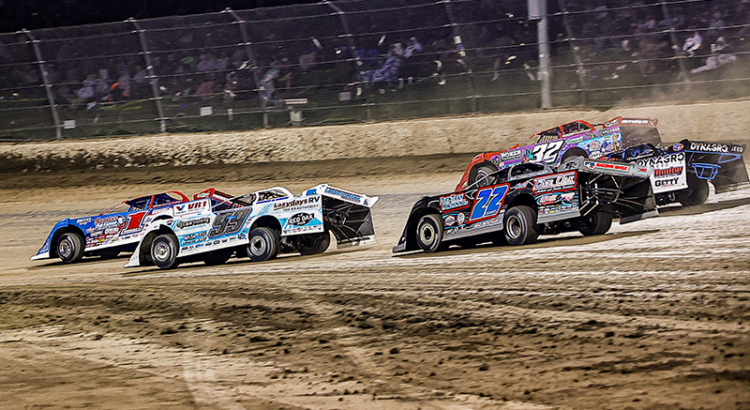
Ever feel like your dirt car has plenty of grip but won't rotate in the middle? Or perhaps it rolls too much and gets loose off the corner, killing your momentum down the straight? The culprit is often your J-bar height and angle. While many racers obsess over spring rates and shock packages, a small tweak to your J-bar (or panhard bar) can transform your handling faster and more effectively.
In the world of dirt late models and modifieds, the J-bar is more than just a piece of steel holding the rear end in place. It is a primary tuning tool used to adapt to changing track conditions. It laterally locates the rear axle while heavily influencing rear roll center height, chassis roll speed, side bite, and load transfer to the right rear tire.
Unlike a standard straight panhard bar often found in asphalt racing, the J-bar is specifically designed for the unique demands of dirt. It is shorter, bent to clear the driveshaft or pumpkin, and typically mounts to the pinion bracket on the right side of the axle. This configuration allows for quicker load transfer and more aggressive rear steer, which is essential for getting a car to turn in and drive off on a clay surface.
In this guide, we will explore why height matters more than you think, how specific adjustments affect your entry, middle, and exit, and provide real-world examples to help you dial in your setup.
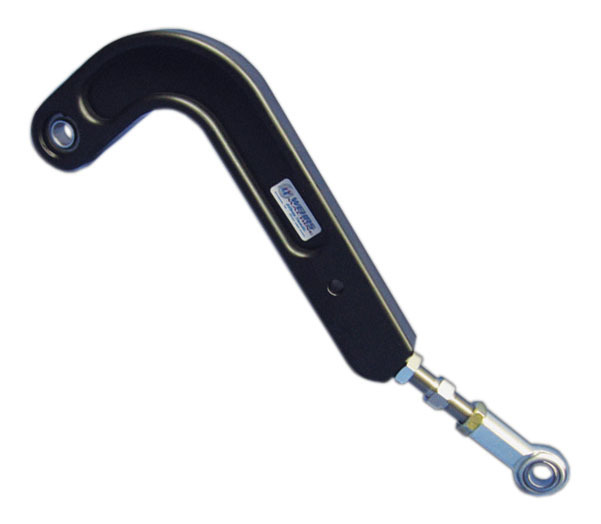
How the J-Bar Works in Dirt Racing
To tune the J-bar effectively, you first need to understand the physics behind it:
- Its core function is to control lateral axle movement, meaning it keeps the rear end centered under the chassis as the suspension travels up and down. However, its tuning power comes from how it sets the rear "roll center."
The Roll Center Concept
Think of the roll center as the invisible pivot point that the chassis leans around. The relationship between the J-bar and the roll center is straightforward but powerful:
- High Roll Center: When you raise the J-bar, you raise the roll center. This shortens the leverage arm between the car's center of gravity and the roll center. The result is less chassis roll and faster load transfer. The car feels stiffer and more responsive.
- Low Roll Center: When you lower the J-bar, you lower the roll center. This increases the leverage arm, allowing the chassis to roll more easily. This slows down the load transfer, making the car feel softer and more forgiving.
The Influence of Angle
On a dirt car, the J-bar is rarely level. It typically features an upward angle from the axle (pinion mount) to the chassis (frame mount). This angle is critical for generating "side bite."
As the car rolls to the right in a corner, an upward-angled J-bar actually pushes down on the right rear tire. This vertical force increases traction at that specific corner of the car. If you need more forward drive or side bite, increasing this angle is often the solution. Conversely, a flatter bar will provide a more neutral feel, evening out the load transfer between the rear tires.
Aero Interaction
For late models, the J-bar height also impacts aerodynamics. A higher J-bar keeps the car flatter (less roll). This keeps the rear spoiler more stable in the air stream, potentially providing more consistent downforce through the center of the corner. If the car rolls over too far (due to a low J-bar), the spoiler angle changes relative to the wind, which can dump downforce just when you need it most.
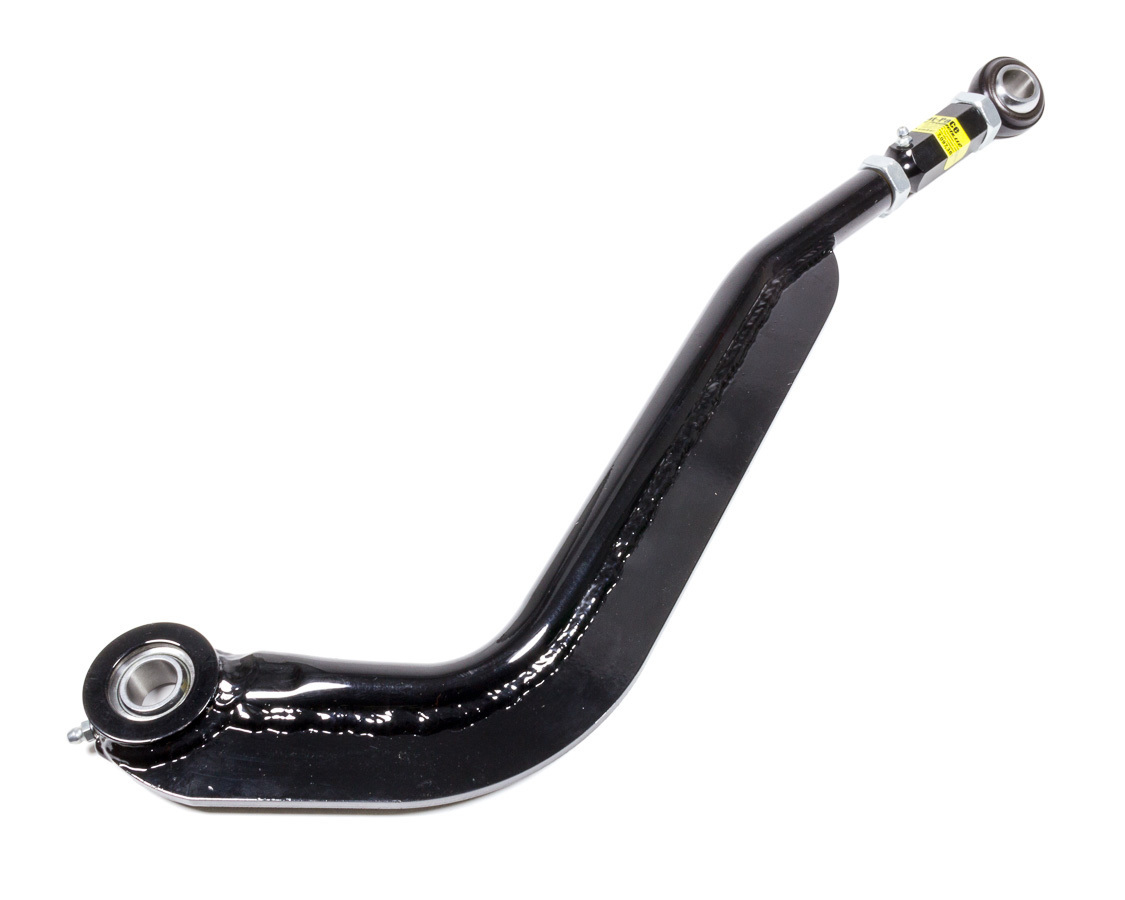
Key Adjustments and Their Real-World Effects
Making the right change at the right time is what separates podium finishers from the rest of the pack. Below is a breakdown of the most common adjustments, followed by a detailed explanation of how they feel from the driver’s seat.
Adjustment Reference Table
|
Adjustment |
How to Make It |
Primary Effect |
Best For |
Driver Feel / Handling Change |
|
Raise J-bar on chassis side (or both ends) |
Move mount up ½–1" increments |
Raises rear roll center → less chassis roll, faster load transfer |
Tacky/grippy tracks, high banks |
Tighter overall, more entry bite, quicker response |
|
Lower J-bar on chassis side (or both ends) |
Move mount down ½–1" |
Lowers roll center → more roll, slower load transfer |
Slick/dry tracks, flat/short tracks |
Looser feel, better mid-corner rotation, more forgiving exit |
|
Lower J-bar on pinion/axle side |
Adjust bracket down |
Increases angle → more right-rear load during roll |
Need more side bite/forward drive |
Adds exit drive, helps when tight off corner |
|
Raise J-bar on pinion side |
Adjust bracket up |
Decreases angle → evens load transfer |
Reduce over-aggressive steer |
Less darty, tighter entry if too loose |
|
Asymmetric changes (chassis only vs. pinion only) |
Adjust one end |
Shifts roll center laterally + changes angle |
Fine-tuning for specific push/loose |
Can tighten/loose without full height change — test carefully |
Raising the J-Bar (Chassis Side or Both Ends)
When the track is heavy, tacky, or high-banked, your car naturally has a lot of grip. In these conditions, excessive chassis roll can make the car feel sluggish or "bound up."
By raising the J-bar, you raise the roll center. This resists body roll. The car will react faster to your steering inputs because it isn't wasting time leaning over before it takes a set. Drivers will describe this as the car feeling "tighter" or more stable. It prevents the right rear suspension from collapsing too far, keeping the car more level and driving forward.
Real-World Example: Imagine you are racing at Eldora or a similar high-banked track early in the night. The clay is heavy and wet. If your J-bar is too low, the car might roll over onto the right rear, causing it to push on entry and then snap loose on exit. Raising the bar 1 inch stiffens the roll, keeping the car platform flat and fast.
Lowering the J-Bar (Chassis Side or Both Ends)
As the night goes on and the track turns black and slick, grip levels drop. If your suspension is too stiff (high roll center), the tires will break traction easily because the load transfer is happening too violently.
Lowering the J-bar lowers the roll center, allowing the chassis to roll more. This motion effectively "plants" the right rear tire more gradually. It creates a softer feel that is much more forgiving on a dry, slick surface. It allows the car to rotate through the center of the corner without snapping loose.
Real-World Example: On slick Michigan tracks like Thunderbird Raceway or local track in the Michigan area, the surface can become like polished concrete. In these scenarios, lowering the J-bar ¾" to 1" allows the body to roll, which helps the car find traction and rotate through the middle of the turn without the driver having to wrestle the steering wheel.
Pinion Side Adjustments (Angle Tuning)
While raising or lowering both ends changes the roll center height, moving just the pinion side (on the axle) changes the angle of the bar.
- Lowering the Pinion Mount: This increases the slope of the J-bar. As discussed earlier, a steeper angle drives the right rear tire into the track harder as the car rolls. This is your go-to move when you are struggling for forward drive off the corner. If the car rotates well but just spins the tires on exit, drop the pinion mount down.
- Raising the Pinion Mount: This flattens the bar. If the car feels "darty" or feels like it creates too much side bite too quickly (causing the car to hike up), flattening the bar can calm the rear end down.
Quick J-Bar Adjustment Cheat Sheet
When you are in the pits and only have a few minutes before the next heat race, you don't have time for physics equations. You need actionable solutions. Use this cheat sheet to diagnose and fix handling issues:
- Tight on Entry or Mid-Corner: The car won't turn. Solution: Lower the J-bar (chassis side). This induces more roll, helping the car rotate.
- Loose Overall or Loose Off: The rear end is sliding out too much. Solution: Raise the J-bar (chassis side). This reduces roll and stabilizes the rear end.
- No Side Bite / No Forward Drive: The tires spin, and the car won't launch. Solution: Lower the pinion side mount. This increases the bar angle, forcing the right rear tire into the track.
- Car Rolls Too Much / Binds Up: The car feels lazy and unresponsive. Solution: Raise the chassis mount. This stiffens the roll characteristics.
Pro Tip: Make one change at a time. Adjusting height and angle simultaneously can confuse the handling picture. Also, rely on driver feedback after 5–10 laps, as tire heat changes the feel.
Advanced Tips & Common Mistakes
Even experienced crews can get tripped up by J-bar adjustments. Here are a few advanced considerations to keep you ahead of the competition.
The Pairing Effect
The J-bar doesn't work in isolation. It works in concert with your 4-link and shock package. For example, if you lower the J-bar to help rotation, you might also need to adjust your shock rebound to control how fast that roll happens. A common pro strategy is to pair a high J-bar (for stability) with a specific 4-link angle that induces rear steer, giving you the best of both worlds: a stable platform that still turns.
The Axle Centering Mistake
This is the most common error in the pits. When you raise or lower the J-bar, you effectively shorten or lengthen the distance between the mount points because the bar travels in an arc. If you make a significant change (like 1 inch) and don't check your axle alignment, your rear end might be shifted ½ inch to the left or right. This puts the tires out of line with the front wheels (dog-tracking), which ruins handling. Always re-measure and center the rear end after a J-bar adjustment.
Tooling Up
Invest in a high-quality, slotted adjustable J-bar bracket. This allows for quick, infinite adjustments without having to unbolt the entire system. Keep a dedicated tape measure and level in your pit cart so you can ensure your angles are precise.
Mastering the Balance
J-bar tuning is one of the most powerful ways to control chassis roll and balance. Unlike springs or shocks, which manage how the suspension absorbs energy, the J-bar dictates the geometry of how the car sets into the corner.
By understanding the relationship between roll center height and bar angle, you can adapt to track conditions as they evolve from tacky to slick. Remember, a higher bar generally tightens the car and speeds up response, while a lower bar loosens it up and aids rotation. Master these adjustments, and you will find yourself with a more consistent, drivable car every time you hit the track.
Recent Posts
-
How Spring Rate Changes Transform Your Dirt Car's Handling
Master Your Dirt Car: How Spring Rates Transform Handling You hit the entry of turn one, pitch the c …Mar 5th 2026 -
Ford 427 Crate Engine: Specs, Performance & FAQ
Unboxing the Beast: A Guide to the Ford 427 Crate Engine When the name "427" is mentioned in Ford c …Feb 25th 2026 -
J-Bar Tuning Guide: Controlling Roll & Balance in Dirt Cars
Master Dirt Track Handling: A Guide to J-Bar Tuning & Adjustments Ever feel like your dirt car has …Feb 17th 2026


