
Single vs. Double vs. Triple Pass Radiators
Single vs. Double vs. Triple Pass Radiators: Which Is Best for Your Dirt Track Race Car?
When you're pushing a dirt track race car to its limits, engine temperature can make or break your night. A radiator that can't keep up leads to overheating, power loss, and—in the worst case—a blown engine sitting in the pits.
But choosing the right radiator isn't as simple as grabbing the one with the most "passes." Single, double, and triple pass radiators each have their strengths and trade-offs. Below, we break them down across the factors that matter most so you can find the right fit for your car, your budget, and your racing conditions.
First, What Does "Pass" Actually Mean?
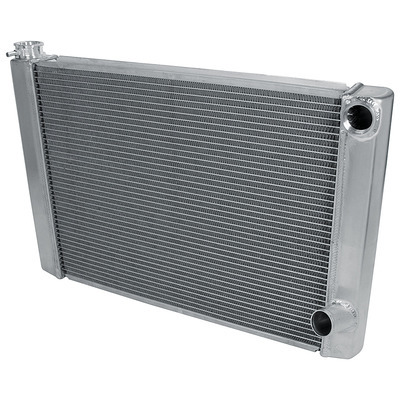
The number of "passes" refers to how many times the coolant travels across the width of the radiator before returning to the engine.
- Single pass: Coolant flows across the radiator once, from one side to the other.
- Double pass: Coolant crosses the radiator twice, taking a U-shaped route before heading back to the engine.
- Triple pass: Coolant makes three trips across the core, following a Z-shaped path.
More passes mean coolant spends more time in the radiator, which generally improves heat transfer—but it also increases flow restriction. That trade-off is at the heart of this comparison.
Cooling Efficiency and Heat Dissipation
This is where the differences show up most clearly.
- Single pass: Offers the least contact time between coolant and the core, so heat dissipation is the lowest of the three. That said, it delivers high flow rates, which can be enough for lower-horsepower engines that don't generate extreme heat.
- Double pass: Roughly doubles coolant dwell time compared to a single pass, striking a solid balance between heat dissipation and flow. For most dirt track applications, this is the sweet spot.
- Triple pass: Maximizes coolant contact time and delivers the best heat dissipation. However, the added restriction slows flow, and without a properly matched high-flow water pump, you can actually see diminishing returns.
Winner: Triple pass for raw cooling capacity, but double pass for balanced, real-world performance.
Cost and Initial Investment
Budget is a real constraint for most dirt track racers, especially those running a full season.
- Single pass: The most affordable option and widely available.
- Double pass: Moderately more expensive due to the internal baffling required to redirect coolant.
- Triple pass: The priciest, thanks to more complex internal construction and the potential need for a supporting high-flow pump.
Winner: Single pass for budget-conscious racers.
Space and Installation Constraints
Dirt track cars often have tight engine bays, and radiator dimensions matter.
- Single pass: Simple inlet/outlet configuration, usually the easiest to fit and plumb.
- Double pass: Inlet and outlet sit on the same side, which can simplify hose routing in some chassis but complicate it in others.
- Triple pass: The most complex plumbing, and the internal baffling can make the unit slightly heavier and bulkier for the same core size.
Winner: Single pass for easy, flexible installation.
Durability and Longevity
Dirt track racing is brutal—vibration, debris, and constant heat cycling all take a toll.
- Single pass: Fewer internal components mean fewer potential failure points.
- Double pass: The internal divider adds a stress point, but quality aluminum construction holds up well under racing conditions.
- Triple pass: More internal baffling means more welds and seams, which can be vulnerable if the radiator isn't well built. Buy from a reputable manufacturer here.
Winner: Single pass for simplicity, though a well-built double pass is nearly as reliable.
Maintenance and Accessibility
Between heats, you need to be able to service your cooling system fast.
- Single pass: Easiest to flush and clean thanks to its straightforward internal path.
- Double pass: Slightly more involved, but still manageable.
- Triple pass: The winding coolant path can trap debris and air pockets, making thorough flushing more time-consuming.
Winner: Single pass for quick, easy maintenance.
Performance Gains and Lap Time Improvements
Cooler engines make more consistent power, and consistency wins races over a long feature.
- Single pass: Adequate for lower-horsepower builds, but may struggle to maintain temps during long green-flag runs.
- Double pass: Keeps temperatures stable through extended runs, helping maintain consistent power and protecting the engine late in a race.
- Triple pass: Offers the best temperature control for high-horsepower engines—provided your cooling system is built to support the added restriction.
Winner: Triple pass for high-horsepower builds, double pass for the majority of racers.
Compatibility With Different Engine Sizes
Matching your radiator to your engine is critical.
- Single pass: Best suited to smaller or lower-output engines (four-cylinders and mild V8s).
- Double pass: Handles a wide range of engine sizes, from mid-range to high-output V8s.
- Triple pass: Designed for high-horsepower, high-heat engines—but overkill (and potentially counterproductive) on smaller builds.
Winner: Double pass for versatility across engine configurations.
Quick Comparison Table
|
Factor |
Single Pass |
Double Pass |
Triple Pass |
|---|---|---|---|
|
Cooling efficiency |
Lowest |
Balanced |
Highest |
|
Cost |
Lowest |
Moderate |
Highest |
|
Installation ease |
Easiest |
Moderate |
Most complex |
|
Durability |
Excellent |
Very good |
Good (build-dependent) |
|
Maintenance |
Easiest |
Moderate |
Most involved |
|
Best engine match |
Small/mild |
Mid to high output |
High horsepower |
The Verdict: Which Radiator Should You Choose?
There's no single "best" radiator—only the best radiator for your setup.
- Choose a single pass if you're running a lower-horsepower engine, racing on a budget, or want the simplest installation and maintenance. It's a smart entry-level choice for weekend and hobby racers.
- Choose a double pass if you want the best all-around performance. For the majority of dirt track racers running mid-to-high output V8s, this is the ideal balance of cooling, cost, durability, and ease of use.
- Choose a triple pass if you're running a high-horsepower engine, racing in hot conditions, or chasing every last bit of temperature consistency—and you're willing to invest in a matching high-flow water pump to get the most out of it.
Our recommendation for most racers: Start with a quality double pass radiator. It delivers the cooling performance you need for competitive racing without the cost, complexity, or diminishing returns that can come with a triple pass setup.
Before you buy, confirm your engine's horsepower and heat output, measure your available space, and match your radiator to your water pump's flow rate. Getting those details right matters far more than simply chasing the highest number of passes.
Recent Posts
-
Single vs. Double vs. Triple Pass Radiators
Single vs. Double vs. Triple Pass Radiators: Which Is Best for Your Dirt Track Race Car? When you'r …Oct 1st 2026 -
Best Engine Oil for 602/604 Crate Racing Engines
Best Engine Oil for 602/604 Crate Racing Engines Quick answer: There is no single "best" oil for 60 …Aug 31st 2026 -
Street Stock Spring Free Height & Diameter Guide
How to Measure Spring Free Height & Diameter for Dirt Street Stocks When you’re replacing springs o …Aug 25th 2026


