
Street Stock Spring Free Height & Diameter Guide
How to Measure Spring Free Height & Diameter for Dirt Street Stocks

When you’re replacing springs or swapping rates on a dirt street stock, free height and diameter are just as important as the rate number. Two springs can both be marked 1000 lb, but if one is a different free height or diameter, your ride height, available travel, and handling will change.
Here’s the correct way to measure them and the most common sizes used on street stocks.
Free Height (Length)
Free height is the overall length of the spring sitting unloaded on a flat surface.
How to measure:
- Stand the spring upright on a flat, level surface.
- Place a straight edge across the top of the coils.
- Measure from the surface up to the bottom of the straight edge at the center of the spring.
- Record the measurement in inches.
Always check that both ends are reasonably square. Springs that have taken a set will sit shorter than their original free height and will lower the car or reduce travel.
Diameter
- Outside Diameter (OD) – the overall width of the spring.
- Inside Diameter (ID) – less critical on most street stock applications since they usually sit in stock-style pockets rather than coil-overs.
Measure across the center of the coils for OD.
Common Sizes on Dirt Street Stocks
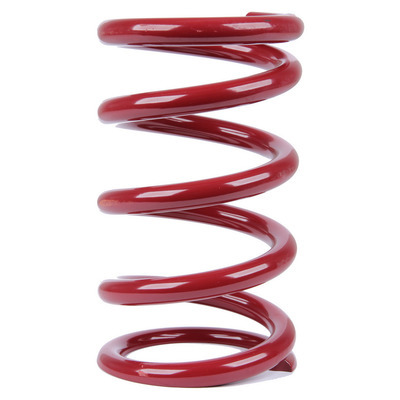
Most dirt street stocks (especially GM metric-based cars) run conventional springs in the stock pockets:
Front
- Most common: 5.5" OD
- Free heights: typically 9.5", 11", or 12"
Rear
- Common options: 5" OD
- Free heights: typically 11" to 16", with 13" and 14" being very popular
Matching both free height and diameter is critical when ordering replacements so the spring seats correctly and maintains proper ride height.
Typical Starting Spring Rate Ranges
These are common baseline ranges for 2800–3400 lb dirt street stocks running stock front pockets. Always treat them as starting points — final rates depend on chassis, weight distribution, track conditions, and rules.
| Corner | Common Rate Range (lb/in) |
|---|---|
| LF | 800 – 950 (sometimes up to 1100) |
| RF | 900 – 1100 (can go higher on heavier or stiffer setups) |
| LR | 175 – 225 |
| RR | 200 – 250 |
Many teams run a stiffer RF than LF (front spring split) to help control roll on entry. Rear rates are usually softer overall, with the RR often a step stiffer than the LR for side bite and stability.
Why Free Height & Diameter Matter When Changing Rates
- A shorter free height spring will lower the car and reach coil bind sooner.
- Different diameters may not seat properly in the spring pocket or perch.
- Springs lose free height and rate over time. Re-measure used springs when possible and mark the actual free height and tested rate on them.
Quick Tips
- Label every spring with free height, diameter, rate, and brand.
- Keep a simple log of what is currently on the car.
- When ordering, always confirm both free height and diameter along with the rate.
Accurate measurements make ordering the right springs much smoother and help keep your front-end geometry and ride heights consistent.
Recent Posts
-
Single vs. Double vs. Triple Pass Radiators
Single vs. Double vs. Triple Pass Radiators: Which Is Best for Your Dirt Track Race Car? When you'r …Oct 1st 2026 -
Best Engine Oil for 602/604 Crate Racing Engines
Best Engine Oil for 602/604 Crate Racing Engines Quick answer: There is no single "best" oil for 60 …Aug 31st 2026 -
Street Stock Spring Free Height & Diameter Guide
How to Measure Spring Free Height & Diameter for Dirt Street Stocks When you’re replacing springs o …Aug 25th 2026


