
Ball Joint Pin Length: Roll Center & Camber Gain Guide
Ball Joint Pin Length: Roll Center, Camber Gain & Geometry for Dirt Cars
Quick Answer: Ball joint pin length directly controls where your dirt race car's roll center sits and how aggressively it gains camber through wheel travel. Longer pins typically raise the roll center and increase camber gain, while shorter pins do the opposite. Getting this relationship right is one of the most impactful—and most overlooked—suspension tuning adjustments available to dirt late model, street stock, and modified racers.
Every racer has felt it: the car that pushes through the center of a corner no matter what you do to the chassis, or the loose-feeling machine that won't stay planted on exit. Sometimes the culprit isn't spring rate, shock valving, or bite—it's something far more fundamental. Ball joint pin length quietly controls two of the most critical aspects of your suspension geometry: roll center height and camber gain. Change it, and nearly everything else changes with it.
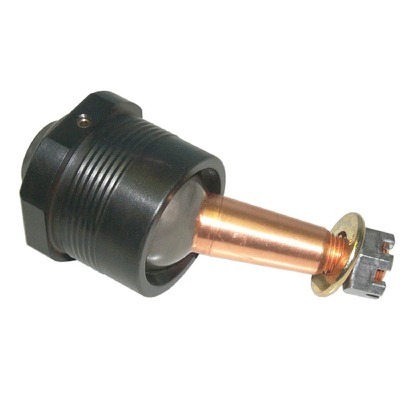
This post breaks down exactly how pin length works, why it matters for dirt racing specifically, and how dirt late model, street stock, and modified racers can use it as a precision tuning tool rather than an afterthought.
What Is Ball Joint Pin Length and How Is It Measured?
Ball joint pin length refers to the distance from the mounting surface of the ball joint to the center of the ball stud itself. On a typical dirt car spindle, this measurement determines where the ball joint's pivot point sits in relation to the control arm and the rest of the suspension geometry.
Even a small change—sometimes as little as a quarter inch—can shift your front suspension's instant centers, which in turn moves your roll center and alters how camber behaves through wheel travel. Longer pins push the pivot point further outboard or upward (depending on orientation), and shorter pins pull it in the opposite direction.
This is why two cars built from the same chassis template can behave very differently depending on the ball joint pins installed. The pins set the geometric foundation that every other suspension adjustment builds on.
How Does Ball Joint Pin Length Affect Roll Center Height?
The roll center is the theoretical point around which the sprung mass of the car rotates when it rolls in a corner. Its height above the track surface has a direct effect on how load transfers during cornering, how the car responds to banking angle, and ultimately how the driver experiences front-end grip.
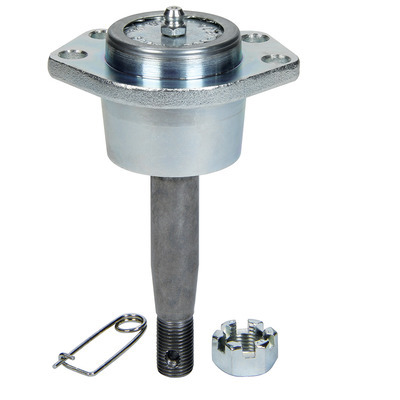
Ball joint pin length influences roll center by shifting the location of the upper and lower ball joint pivot points relative to each other and to the ground. These pivot points define the instant center of each control arm, and the line drawn from each instant center to the tire contact patch determines where the roll center falls.
For dirt racing, roll center height is particularly critical because track conditions change lap by lap. A tacky track early in the night rewards a higher roll center that promotes aggressive weight transfer and rear bite. As the track dries and slicks off, a lower, more stable roll center often helps maintain front-end traction without the car wanting to push up the banking.
Longer upper ball joint pins generally raise the roll center by moving the upper pivot point outboard, which raises the instant center. This increases weight transfer leverage—useful on heavy, tacky conditions—but can make the car difficult to drive on a slick surface. Shorter pins lower the roll center and soften the car's roll response, which tends to work better on dry-slick tracks where throttle control matters more than horsepower.
How Does Pin Length Change Camber Gain Through Wheel Travel?
Camber gain describes how a wheel's camber angle changes as the suspension moves through bump and rebound. Because dirt race cars run on uneven, rutted surfaces, the suspension is constantly cycling through its travel range. Managing how much camber changes—and how quickly—is essential for keeping the contact patch flat and the tire working efficiently.
Ball joint pin length alters the arc that the wheel follows during suspension travel. A longer pin moves the ball joint pivot point further from the control arm's mounting axis, which effectively changes the radius of that arc. Longer pins increase the rate of camber gain, meaning the wheel picks up negative camber more aggressively as it travels into bump. Shorter pins produce a more gradual camber change.
For dirt late models, which run significant static negative camber on the left front, moderate camber gain on the right front helps the tire stay loaded through the center of the corner without rolling onto its outer edge. Too much camber gain on the right front—often caused by running too long a pin—can create an abrupt, unpredictable mid-corner push as the tire contact patch becomes inconsistent over bumps.
Street stocks and modifieds, which often run narrower front-end geometry and less suspension travel than late models, are particularly sensitive to this relationship. A small pin length change on these cars can produce noticeably different camber behavior across the same set of corners.
How Does Pin Length Interact with Caster, Toe, and Kingpin Inclination?
Suspension geometry is never a collection of isolated variables. Adjusting pin length ripples through caster, toe change through travel, and kingpin inclination (KPI) simultaneously.
Caster is affected because moving the upper ball joint pivot point changes the angle of the steering axis.
More caster—often a byproduct of certain pin length combinations—adds camber change during steering input, which can help or hurt depending on how much front steer the car runs. On a dirt modified running a large amount of left rear steer, for example, unwanted caster change from a pin swap can make the car fight itself through the center of a corner.
KPI, the inward tilt of the steering axis, also shifts with pin length. Higher KPI tends to produce more positive camber on the outside wheel during turns, which is generally undesirable. Keeping KPI within a reasonable range while tuning pin length requires checking full geometry calculations, not just measuring one angle at a time.
Toe change through travel—sometimes called bumpsteer—is another downstream effect. Anytime the ball joint pivot points move, the arc the tie rod needs to match changes as well. After any pin length adjustment, checking and correcting bumpsteer with a bumpsteer gauge is not optional; it's a necessary step.
Practical Pin Length Selection for Dirt Late Models, Street Stocks, and Modifieds
Track conditions should drive pin length decisions as much as any other chassis setting.
On heavy, high-grip tracks: A slightly longer upper ball joint pin raises the roll center and increases camber gain, supporting more aggressive weight transfer and helping the car rotate off the corners. Dirt late models on fresh, tacky tracks often benefit from this setup, especially at higher-banked tracks where the car needs to utilize the banking efficiently.
On dry-slick tracks: Reducing pin length lowers the roll center and softens camber gain, producing a more planted, forgiving front end. Street stocks and modifieds—cars that are often driven at tracks that go through the full spectrum from tacky to slick in a single night—should have baseline pin length settings established for each condition rather than relying on a one-size-fits-all approach.
When transitioning from asphalt to dirt: Asphalt setups typically run much lower roll centers and far less camber gain than dirt setups. Racers who compete on both surfaces should treat pin length as a primary adjustment point in that transition, not just springs and shocks.
Start with manufacturer-recommended baseline pin lengths for your specific spindle and control arm combination, then make incremental changes of a quarter inch at a time. Document every change alongside your lap times and driver feedback to build a reliable reference chart for your program.
Build Your Geometry Knowledge, One Adjustment at a Time
Ball joint pin length sits at the intersection of roll center, camber gain, caster, KPI, and bumpsteer. Understand it, and you hold one of the most powerful geometry tools available to any dirt racer running a late model, street stock, or modified. Ignore it, and you'll spend time chasing handling problems that a well-chosen pin could have solved in the shop before the trailer ever left home.
The best approach is methodical. Pick one track condition, establish a baseline, make deliberate changes, and measure the results on the stopwatch. Experienced dirt racers know that the setup notebook is just as important as the car itself.
Frequently Asked Questions
What does ball joint pin length do on a dirt race car?
Ball joint pin length sets the position of the ball joint pivot point relative to the control arm and spindle. This position determines the location of suspension instant centers, which control both roll center height and the rate of camber gain through wheel travel—two of the most important handling variables on a dirt race car.
How does a longer ball joint pin affect handling?
A longer upper ball joint pin generally raises the roll center and increases camber gain. This tends to produce more aggressive weight transfer in corners, which can improve rotation and rear bite on high-grip, tacky track surfaces. On slick tracks, it can make the car harder to drive consistently.
How much does pin length affect roll center height?
The exact effect varies by chassis geometry, but even a quarter-inch change in pin length can shift the roll center by a meaningful amount—sometimes an inch or more—depending on control arm angles and the existing geometry of the front suspension.
Should dirt late models, street stocks, and modifieds use different pin lengths?
Yes. Each car class runs different spindle designs, control arm lengths, and suspension geometry baselines, so optimal pin length varies by class. Modifieds and street stocks are often more sensitive to small pin changes due to their narrower geometry packages compared to late models.
What should I check after changing ball joint pin length?
After any pin length change, always re-check bumpsteer with a bumpsteer gauge, verify static camber and caster settings, and review your roll center calculation if you have the geometry data. Bumpsteer, in particular, can shift significantly and should not be assumed to remain unchanged after moving ball joint pivot points.
Is pin length the same as ball joint stud length?
Not always. Pin length in the context of suspension geometry specifically refers to the distance from the ball joint's mounting face to the center of the ball stud pivot—not the full stud length. Always use this measurement when calculating geometry changes.
Recent Posts
-
Best Engine Oil for 602/604 Crate Racing Engines
Best Engine Oil for 602/604 Crate Racing Engines Quick answer: There is no single "best" oil for 60 …Aug 31st 2026 -
Street Stock Spring Free Height & Diameter Guide
How to Measure Spring Free Height & Diameter for Dirt Street Stocks When you’re replacing springs o …Aug 25th 2026 -
Ball Joint Pin Length: Roll Center & Camber Gain Guide
Ball Joint Pin Length: Roll Center, Camber Gain & Geometry for Dirt Cars Quick Answer: Ball joint pi …Aug 17th 2026


